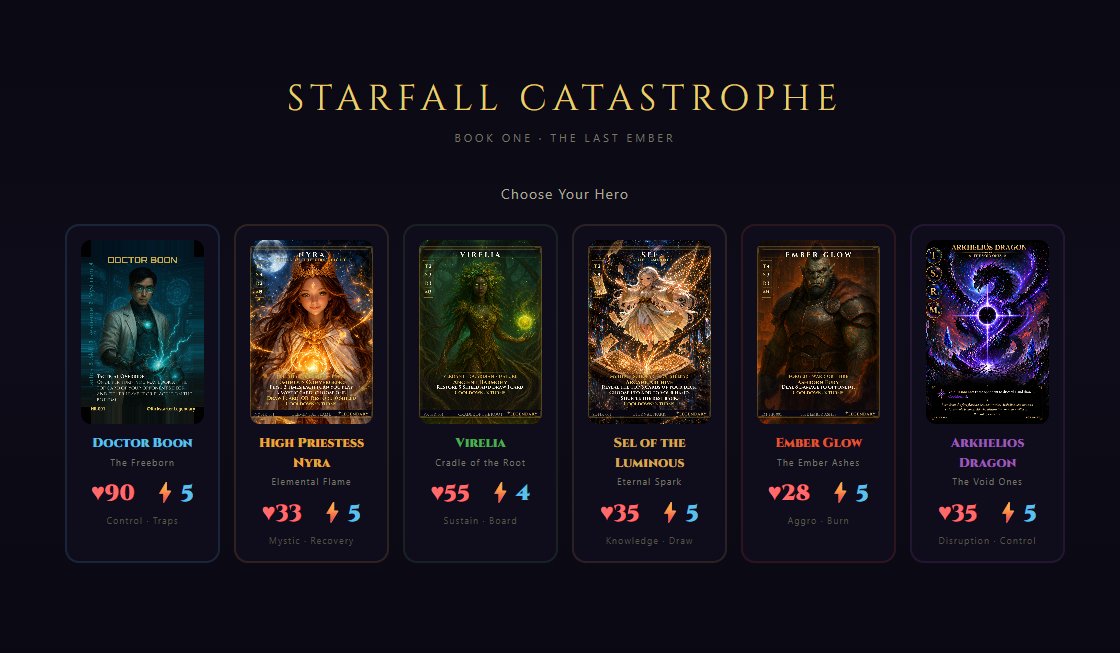
Every trading card game lives or dies by balance. If one hero dominates, the meta collapses. If another is unplayable, forty cards become worthless cardboard. Starfall Catastrophe has six heroes with 240 unique cards — and every single matchup needs to feel fair.
This is the story of how we got there.
The Problem: Six Heroes, Fifteen Matchups
With six heroes, there are fifteen unique head-to-head pairings. Each hero has a completely different deck identity — Doctor Boon controls with traps and information warfare, High Priestess Nyra sustains through sacred fire and shield recovery, Virelia builds boards of nature spirits that heal each other, Sel of the Luminous cycles through cards at terrifying speed, Ember Glow burns fast with aggressive damage, and Arkhelios Dragon denies resources through forced discards and energy drain.
Making all of them viable against each other is not something you can eyeball. You need data.
Monte Carlo Simulation: Let the Machines Play
We built a Monte Carlo simulation engine that plays thousands of AI-vs-AI games automatically. The engine parses every card effect text directly from our master CSV — the same file that generates the physical cards — so what gets simulated is exactly what gets printed.
Each simulation run plays 1,000 games per matchup with randomized initiative, shuffled decks, and an AI that makes priority-based decisions: damage when the opponent is low, heal when you are low, draw for card advantage, allies for board presence. It is not perfect play, but it is consistent enough to reveal systemic imbalances.
15 matchups x 1,000 games = 15,000 simulated games per run. We ran dozens of iterations.
The Rules That Matter
The simulator enforces every rule that affects balance:
Summoning Sickness — allies cannot attack the turn they are played. This prevents snowball openers.
Initiative Roll — random d6 determines who goes first. The first player cannot attack on turn 1.
Deckout — if your deck is empty and you must draw, you lose. This punishes over-aggressive draw engines.
Energy per Turn — calculated from each hero Mysticism stat (3 + M/2). Higher M = more cards per turn.
Trap Limits — set by Tactics attribute. Doctor Boon (T5) gets five trap slots; Virelia (T2) gets two.
Field Passives — allies that generate bonus energy, boost action damage, or heal at end of turn.
Conditional Effects — cards that deal bonus damage when you control certain ally subtypes, or when your shield is below a threshold.
What We Found (And Fixed)
The first simulation runs were brutal. Doctor Boon won 0% of his games — not a single one out of 5,000. His printed card effects include complex mechanics like copying passive abilities and redirecting damage that the simulator could not fully resolve. Meanwhile, Sel of the Luminous was winning 65% overall thanks to her S5 stat giving a massive 50% bonus to all action damage.
We went through multiple balance passes:
Pass 1: Shield Calibration. Each hero starting shield was tuned independently. Boon went from 35 to 90 to 110. Nyra dropped from 75 to 33. Virelia climbed from 22 to 55. These are not arbitrary — they compensate for each deck inherent power curve.
Pass 2: Rule Validation. We discovered that adding Skill-based damage bonuses (S x 10% to all actions) broke balance completely — Sel S5 made her actions deal 50% bonus damage, creating an unwinnable matchup for lower-S heroes. We removed the Skill bonus from the engine entirely.
Pass 3: Summoning Sickness Impact. Adding summoning sickness disproportionately hurt ally-heavy decks like Boon and Virelia. Their strategy depends on building board presence, but now every ally takes a full turn before it contributes to attacks. This required rebalancing shields upward for board-focused heroes.
The Final Numbers
After all balance passes, here is where the six heroes landed:
| Hero | Shield | Win Rate | Status |
|---|---|---|---|
| Doctor Boon | 110 | 49.3% | Balanced |
| High Priestess Nyra | 33 | 49.1% | Balanced |
| Virelia | 55 | 46.6% | Balanced |
| Sel of the Luminous | 35 | 51.1% | Balanced |
| Ember Glow | 28 | 49.0% | Balanced |
| Arkhelios Dragon | 35 | 54.9% | Balanced |
15 out of 15 matchups balanced. Every single pairing falls within the 40-60% win rate window. No hero dominates. No hero is unplayable.
Why Shield Values Look Strange
If you look at the shield numbers — 110, 33, 55, 35, 28, 35 — they seem random. They are not. Each value is the result of thousands of simulated games finding the exact number where that hero win rate crosses the 50% line against the field.
Doctor Boon needs 110 Shield because his complex trap mechanics (copy, redirect, cancel, delay) cannot be fully simulated — in real play with a human pilot, those effects are devastating. The high shield compensates for what the AI cannot do. Ember Glow only needs 28 Shield because his deck is pure aggression — every card deals damage, and games end fast.
234 Cards, 490 Effect Clauses, 100% Coverage
The balance simulation was only possible because we built a complete effect parser. Every card in the game — all 234 deck cards across six heroes — has every effect clause recognized and implemented. That is 490 individual effect clauses: damage, healing, draw, energy manipulation, conditional bonuses, passive field effects, trap triggers, death triggers, AoE damage, cost discounts, and more.
What This Means For You
When you open a Starfall Catastrophe deck — any of the six — you are holding a competitive deck. Not a starter that needs upgrades. Not a budget option that loses to the premium pick. A real, balanced, complete deck that can win against any opponent.
That is the promise of Book One: The Last Ember. Six heroes. 240 cards. Zero pay-to-win. Verified by 15,000 simulated games.
Play the prototype at starfallcatastrophe.com/play