Prologue — The Long Silence
The six heroes of the First Catastrophe are dead. Not tragically, not violently — they simply lived, aged, and passed, as all things do. The counter-harmony they delivered into the rift bought the world not eternity, but time. And time did what time does: it buried everything.
Doctor Boon became a folk figure — "the Trickster Who Talked to Machines," a children's story. Nyra's fire temples still burn, but her followers worship a saint, not a memory. Virelia's forest grew so vast it swallowed three kingdoms, and no one remembers it once walked. Sel's library collapsed into the sea during a quake centuries ago; scholars debate whether it ever existed. Ember Glow became a war cry, then a drinking song, then silence. Arkhelios became a word for nightmares — arkhelion, a fear without shape.
Three thousand years have passed.
The world rebuilt. New civilisations rose. New languages. New gods. The scar in the sky where the rift once opened became a constellation called "The Closed Eye" — a symbol of peace, of danger averted, of a story that ended.
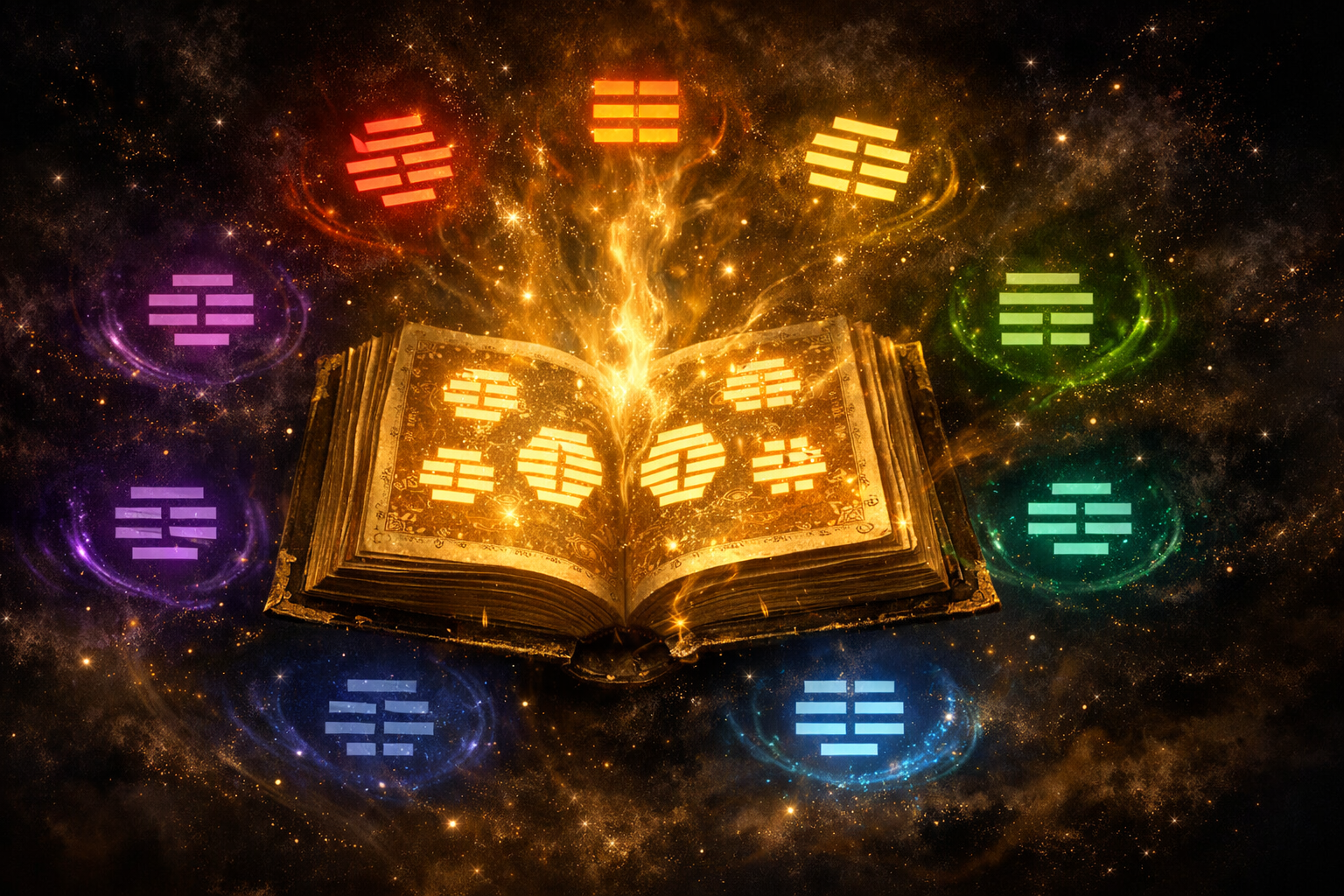
But the I-Ching, kept in a monastery older than any nation, never stopped turning its pages in the wind. The monks who guard it do not read it. They listen. And for three thousand years, the book has been humming the same low note — a note that recently began to change.
The Shard Wakes
Deep beneath the world, in places where geology becomes theology, the twelve shards that fell during the First Catastrophe never fully died. The counter-harmony silenced their song, but silence is not absence. In the darkness, pressed between tectonic plates and the roots of dead volcanoes, the shards have been composing.
The signal learned from its defeat. It studied the counter-harmony — the frequencies of resistance, the shapes of defiance — and spent three millennia rewriting itself. The new signal doesn't corrupt. It perfects.
The first signs are beautiful. A village wakes to find every crop in full bloom overnight. A river that has flooded for centuries suddenly flows in perfect equilibrium. A child born deaf begins to hear — but only a melody no one else can perceive. A war between two kingdoms ends overnight when both armies lay down their weapons, smiling, unable to remember why they were fighting.
The world celebrates these miracles. Only the monks at the I-Ching monastery recognise the pattern. The book's pages are turning faster now, and the hexagrams are rearranging themselves into a sequence the oldest monk has only read about in forbidden commentaries: The Sequence of Returning — the pattern that plays before a cycle repeats.
The monastery sends out eight summons. Not letters. Not messengers. The book itself reaches out — each of the eight trigrams resonating with a living soul somewhere in the world whose nature perfectly embodies that principle. These eight feel the call differently: one hears thunder in a clear sky, another feels the ground beneath them breathe, another watches their reflection in a lake move independently.
They are not chosen because they are powerful. They are chosen because they are true.